News

Spotlight on Science: Poster Viewing at ESHRE 2026

1 day ago

Share this post

POSTER REVIEW

At ESHRE 2026, the MIM Fertility team was proud to showcase our latest research and innovations highlighting the transformative role of AI in assisted reproduction.

We presented four posters demonstrating how our AI solutions support embryologists and clinicians in achieving better outcomes.

If you’re interested in reading our posters in full click here.

P-166: AI-based automation of Gardner blastocyst grading to improve standardisation across IVF centres
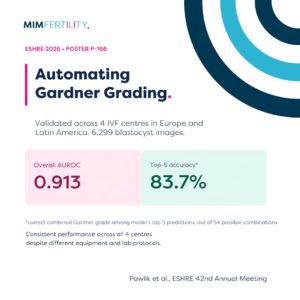
Poster Overview: P-166: AI-based automation of Gardner blastocyst grading to improve standardisation across IVF centres - Presented at ESHRE 2026.

P-876: Clinical performance of AI-based follicular monitoring in routine IVF care
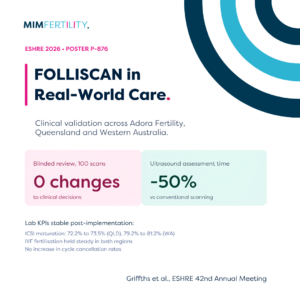
Poster Overview: P-876: Clinical performance of AI-based follicular monitoring in routine IVF care - Presented at ESHRE 2026.

P-784: Automated assessment of follicle number per ovary for standardized detection of polycystic ovarian morphology
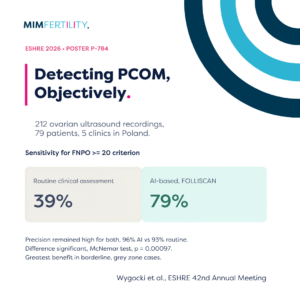
Poster Overview: Automated antral follicle count for prediction of low and high ovarian response: a prospective study - Presented at ESHRE 2026.

P-827: Automated antral follicle count for prediction of low and high ovarian response: a prospective study

Poster Overview: Automated antral follicle count for prediction of low and high ovarian response: a prospective study - Presented at ESHRE 2026.

Together, these contributions underline how MIM Fertility’s AI tools are helping clinics worldwide redefine standards in fertility care.

These posters reflect our mission to empower fertility professionals with cutting-edge AI tools that enhance precision, reduce workload, and improve patient outcomes. By combining clinical expertise with innovative technology, MIM Fertility is shaping the future of assisted reproduction, one breakthrough at a time.

We’re grateful to ESHRE 2026 and the wider fertility community for the opportunity to share this work – and excited for what’s next.

Want to get in touch? Click here to contact us.
Share this post

You might be also interested in

Breaking news from MIM Fertility

2 weeks ago

Article written by Keshav Malhotra – Embryologist  · Chair Embryology, ISAR · Chair, Embryology SIG, ASPIRE  ·  Executive Member, Alpha Scientists in Reproductive Medicine. A patient sat across from me a couple of days back holding a printout. It was an embryology report, a single page with her embryos listed and graded. She pointed to one […]

3 weeks ago

We’re excited to announce that MIM Fertility will be attending ESHRE 2026 in London, one of the world’s leading events in reproductive medicine and embryology. From 5 to 8 July at ExCeL London, you’ll find us at Booth C27, where we will show how AI is reshaping everyday IVF practice, from embryo assessment to follicle […]

1 month ago

Article written by Keshav Malhotra – Embryologist  · Chair Embryology, ISAR · Chair, Embryology SIG, ASPIRE  ·  Executive Member, Alpha Scientists in Reproductive Medicine   A colleague of mine, a senior embryologist with over two decades in the lab, sat across from me at a conference dinner last year and said something I have been […]

2 months ago

There’s a question every MedTech company must answer at some point: do you build everything yourself, or do you find the right people to build with? For us, the answer just became official. We’re proud to announce that MIM Fertility has entered a formal partnership with Esco Medical – integrating our AI embryo assessment tool, […]

2 months ago

In every high-performing IVF clinic, there is a role that rarely makes it onto a conference stage or a marketing brochure and yet, without it, the entire treatment chain can slow down, fragment, or fail. The fertility nurse. Patients often interact with nurses more frequently than with their reproductive endocrinologist. Embryologists rely on them to translate […]

Are you a medical professional?

This content is intended exclusively for qualified medical professionals and may include specialized information that should not be interpreted by individuals without appropriate medical training.