
MIM Fertility Presents New Research at ASRM 2025: AI Matches Expert Sonographers in Follicle Size Measurement
At this year’s ASRM 2025 Congress in San Antonio, MIM Fertility presented new research evaluating the accuracy of FOLLISCAN, our AI model for automated ovarian follicle measurement. The study explored a key question in IVF monitoring: Can AI measure follicle size as reliably as experienced sonographers, without adding variability?
Why This Matters
Precise follicle measurements guide critical clinical decisions, including timing of the trigger shot and predicting oocyte yield. Yet these measurements can vary between clinicians and across ultrasound machines. Reducing that variability is essential for standardization and better patient care.
What We Studied
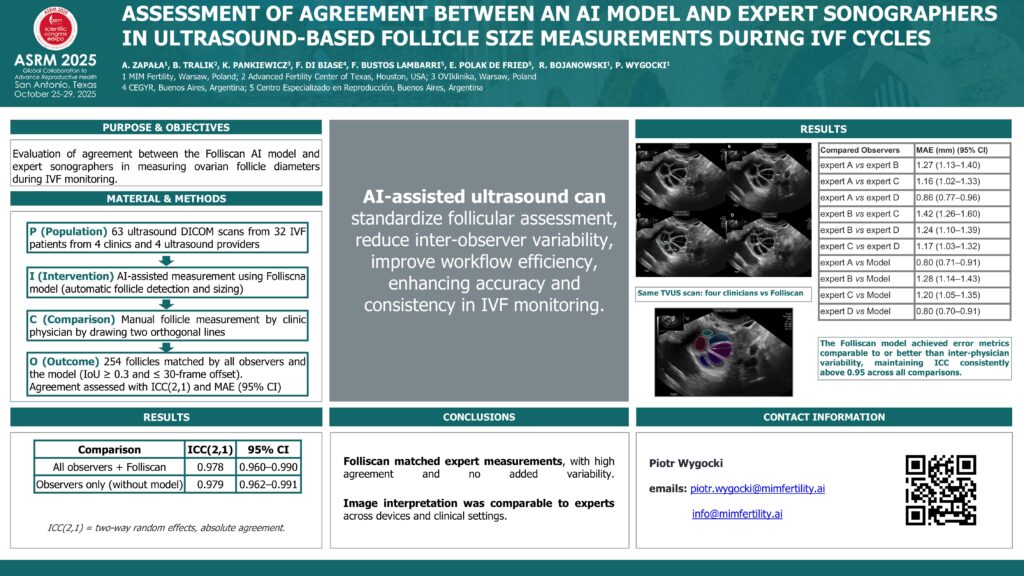
Our team analyzed 63 ultrasound DICOM scans from 32 IVF patients across four clinics in the U.S., Argentina, and Poland—each using different ultrasound systems.
Every scan was independently annotated by a physician, who measured follicles manually using orthogonal diameters. Folliscan applied the same measurement logic automatically.
Using a rigorous matching method (Intersection-over-Union), 254 follicles were confirmed as the same across all clinicians and the AI model. These matched follicles formed the basis of our agreement analysis.
Key Findings
Folliscan achieved expert-level agreement with human sonographers:
- ICC (2,1): 0.978 (96%–99% CI): excellent agreement, unchanged when the AI was excluded
- MAE (mean absolute error):
- Between experts: 0.86–1.42 mm
- Between experts and Folliscan: 0.80–1.28 mm
In several comparisons, the AI’s performance fell at the lower end of human variability—indicating that the model is at least as consistent as experienced clinicians. Performance was robust across clinics, geographies, and ultrasound devices, reinforcing real-world applicability.
What This Means for IVF Clinics
The results show that AI-assisted ultrasound can standardize follicle assessment, reducing inter-observer differences and supporting more consistent treatment decisions.
Potential clinical benefits include:
- More reliable trigger-day planning
- Improved workflow efficiency
- A built-in quality-assurance layer
- Support for large or multi-site clinic networks
- Faster onboarding for new staff
Next Steps
While this multi-center study demonstrates strong agreement, future research will assess:
- Larger datasets
- Operational time savings
- Impact on clinical outcomes such as oocyte yield
- Device-specific performance
- Integration into real-world clinic workflows
- Conclusion
Folliscan achieved measurement accuracy equivalent to expert sonographers, without increasing variability—even across different ultrasound machines and clinical settings. This research underscores the promise of AI-assisted ultrasound to enhance accuracy, consistency, and efficiency in IVF monitoring.